




Hot Tags
Wood Curtain Coater for UV High-Gloss Wood Panel Finishing
October 19, 2026


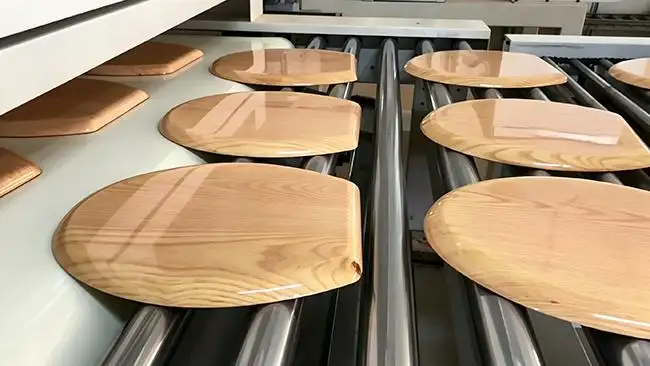
A mirror-like UV finish exposes defects that may remain unnoticed on matte wood panels. Small variations in wet-film thickness, coating viscosity, curtain stability or leveling can appear as waves, orange peel, bubbles or uneven gloss after curing.
For this reason, selecting a Wood Curtain Coater is not simply a matter of choosing the correct working width. High-gloss finishing requires the coating machine, paint circulation, panel transport, leveling process and UV curing system to work as one controlled process.
Why Use a Wood Curtain Coater for High-Gloss UV Finishing?
A Wood Curtain Coater creates a continuous sheet of liquid coating from a precision knife head. Flat panels move underneath this falling curtain without a coating roller physically contacting the finished surface.
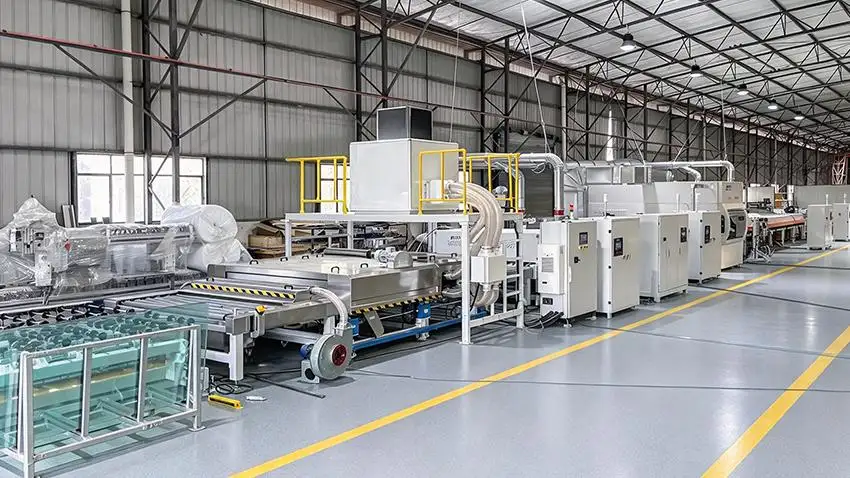
This non-contact application is particularly useful when a relatively high-build, smooth topcoat is required. SENLIAN's UV curtain coating line, for example, combines roller-applied primer stages with curtain-applied high-gloss topcoats for flat panels such as cabinet doors and decorative boards.
The final appearance, however, depends on several connected variables:
Paint Temperature → Viscosity → Curtain Flow → Wet-Film Formation → Leveling → UV Curing
A problem at any stage may remain visible after the coating is cured.
How Does a Wood Curtain Coater Control the Wet Film?
Paint Flow and Knife Adjustment
The coating must reach the knife head at a stable flow rate. The knife opening and coating supply then influence how the liquid curtain forms across the working width.
Increasing the knife opening alone does not automatically guarantee a thicker, uniform coating. Applied film also depends on:
•Coating viscosity and density
•Paint flow rate
•Conveyor speed
•Curtain width
•Substrate condition
•Leveling behavior
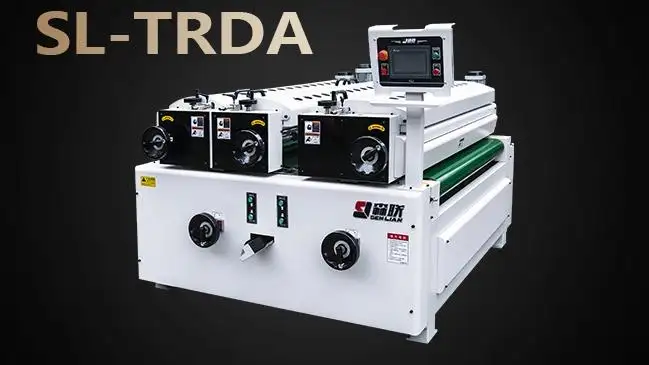
SENLIAN uses a mechanical flip-style knife head adjusted by a handwheel and multiple screws. Its coating gap and knife position can be changed for different coating requirements, while the larger paint cavity can support applications requiring additional material flow.
Conveyor Speed
As a panel travels faster beneath the curtain, the relationship between coating supply and substrate throughput changes. Therefore, conveyor speed should be established together with coating flow rather than treated as an independent productivity setting.
The practical target is not maximum speed. It is a repeatable wet film that has sufficient time to level before curing.
Why Curtain Stability Matters for High-Gloss Panels
A high-gloss surface makes transverse film variation easy to see. Mechanical disturbance around the knife head can affect the falling curtain and later appear as waviness or inconsistent gloss.
This is one reason machine structure matters.
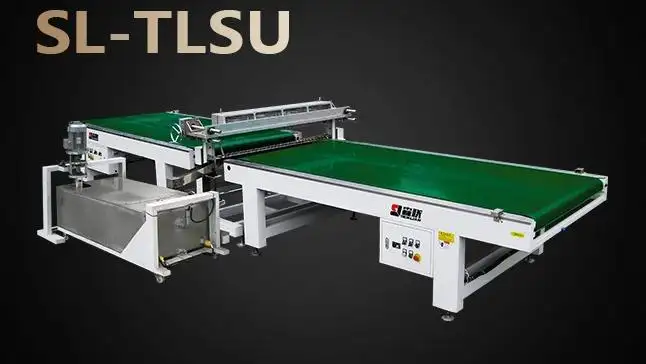
SENLIAN's split Wood Curtain Coater separates the independent knife body from the two conveyor sections. The design reduces mechanical influence from panel conveying around the coating area, helping maintain a more stable falling curtain.
The coating system can also use a filtering box or heating-and-filtering box. Filtration removes bubbles and contaminants before the coating reaches the knife, while a low-speed heavy-duty impeller pump supplies coating continuously to the knife body.
For high-gloss finishing, these details matter because trapped air or contamination can become highly visible after UV curing.
How Paint Condition Affects Surface Defects
| Paint Condition | Process Effect | Possible Result |
| Viscosity too high | Poor flow and leveling | Orange peel |
| Unstable viscosity | Changing curtain behavior | Gloss variation |
| Entrained air | Interrupts wet surface | Bubbles or pinholes |
| Contamination | Disturbs coating film | Surface particles |
| Unstable supply | Curtain thickness changes | Uneven film |
There is no universal viscosity setting for every Wood Curtain Coater. The correct operating window should be established from the coating supplier's technical data, actual application temperature, required film build and production trial.
Wood Curtain Coater vs Roller Coater
Neither process is universally better. They often perform different jobs in the same UV finishing line.
| Factor | Wood Curtain Coater | Roller Coater |
| Application | Non-contact liquid curtain | Direct roller transfer |
| Typical use | High-build/high-gloss topcoat | Primer and controlled layers |
| Surface contact | No application roller | Roller contacts panel |
| Film formation | Continuous liquid layer | Metered roller layer |
| Best substrate | Flat panels | Flat panels |
| Complex profiles | Limited | Limited |
A practical UV line may therefore use roller coating for primer build and a Wood Curtain Coater for the final high-gloss topcoat, rather than choosing one technology for every layer. SENLIAN's published UV line follows this type of process combination.
Why Leveling Must Come Before UV Curing
Fast UV curing is useful only after the wet film has reached the required surface condition.
Immediately curing a poorly leveled coating can lock in:
•Waves
•Orange peel
•Air bubbles
•Flow marks
•Local thickness differences
A more complete sequence is:
Wood Curtain Coater → Leveling/IR Heating → UV Curing
SENLIAN's UV curtain coating workflow places a leveling stage between curtain topcoating and UV curing. Its process description notes that heating promotes paint leveling and helps address waviness, bubbles and orange peel before curing.
Common High-Gloss Defects and What to Check
| Defect | Likely Cause | Check First |
| Waves | Curtain instability or poor leveling | Knife, vibration, leveling |
| Orange peel | High viscosity or inadequate leveling | Paint condition |
| Bubbles | Air in coating | Filter and circulation |
| Uneven gloss | Wet-film variation | Knife, flow, conveyor |
| Particles | Contamination | Filtration and cleaning |
| Poor adhesion | Surface or primer problem | Pretreatment and primer |
| Under-cure | Insufficient UV exposure | UV system and line speed |
This diagnostic approach is more useful than changing several machine settings simultaneously. Adjust one controlled variable, measure the result and then establish a stable process window.
How a Wood Curtain Coater Fits into a Complete UV Line
A typical high-gloss wood panel process may follow:
Sanding → Dust Removal → Primer Roller Coating → Intermediate Sanding → Wood Curtain Coater → Leveling → UV Curing → Inspection
The quality of the curtain-coated topcoat depends heavily on the stages before it. MDF, veneer and other wood-based surfaces should be sufficiently flat, clean and sealed before the high-gloss coating is applied.
Flat cabinet doors, MDF panels and veneers are natural candidates. Deep grooves, raised profiles or complex three-dimensional parts may require a different application method, such as spraying.
What Should Buyers Verify Before Selecting a Wood Curtain Coater?
Machine selection should start with the actual production process rather than catalogue specifications alone.
Buyers should define:
•Maximum and minimum panel dimensions
•UV coating type and viscosity range
•Required wet-film build
•Existing or planned conveyor speed
•Primer and sanding process
•Required leveling stage
•UV curing configuration
•Cleaning and coating-change requirements
SENLIAN lists standard maximum coating widths of 600 mm, 800 mm and 1300 mm for its SL-TLSU series, while the machine can also be configured around working size, knife-head design, paint container, conveyor arrangement and electrical requirements.
More importantly, buyers should conduct a production trial using their actual panel and UV coating. Check coating uniformity at the center and both edges, then inspect gloss, waves, bubbles, orange peel, adhesion and cure quality after finishing.
Match the Wood Curtain Coater to the Process, Not Just the Panel Width
A high-gloss result comes from the interaction of substrate preparation, coating rheology, curtain stability, wet-film control, leveling and UV exposure. A Wood Curtain Coater should therefore be evaluated as part of the complete finishing process rather than as an isolated coating machine.
For manufacturers developing or upgrading a UV high-gloss wood panel line, SENLIAN's Split Curtain Coating Machine provides options for different panel widths, coating conditions, knife-head arrangements, filtration systems and conveyor layouts. Its independent coating structure is particularly relevant where stable curtain formation and integration with downstream leveling and UV curing are important.
Manufacturers can review the SENLIAN Curtain Coating Machine configuration and discuss actual panel dimensions, coating characteristics and line requirements before defining the final Wood Curtain Coater setup.
FAQs
Q1. What materials can the SENLIAN Wood Curtain Coater process?
It is designed mainly for flat materials such as wood panels, MDF, veneer and similar sheet products used in coating lines.
Q2. What coating types can the SENLIAN curtain coater handle?
SENLIAN lists compatibility with coating systems including UV, PU and PE, subject to the actual coating formulation and process requirements.
Q3. Why does SENLIAN use a split curtain coating structure?
The coating body is separated from the conveyor sections to reduce mechanical influence from panel transport on the falling paint curtain.
Q4. How is the coating knife adjusted?
The SENLIAN machine uses a mechanical flip-style knife head with handwheel and screw adjustments for controlling knife position and coating gap.
Q5. Does the SENLIAN Wood Curtain Coater include paint filtration?
Filtration options are available, including a filtering box and a heating-and-filtering configuration for paint conditioning.