



Hot Tags
5-Axis Furniture Spraying Machine for Complex Furniture Parts: A Technical Guide
October 19, 2026


A flat cabinet panel is relatively straightforward to spray. A raised door, thick edge, recessed profile, frame, or shaped furniture component is different. As surface geometry changes, the spray gun must manage not only position but also distance, angle, travel speed, overlap, and paint delivery.
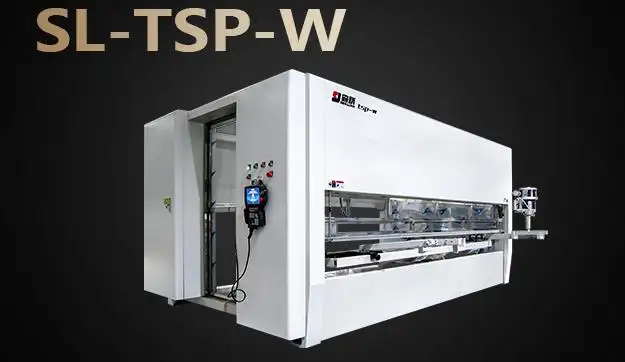
This is where a 5-axis Furniture Spraying Machine becomes useful. Its main advantage is not simply having more motion axes. It gives the spraying system greater control over how the gun approaches changing surfaces.
Why Are Complex Furniture Parts Difficult to Spray?
With a simple reciprocating system, the spray gun normally follows a predictable path over a relatively flat surface. Complex furniture creates additional coating conditions.
| Geometry | Typical Risk | Main Cause |
| Flat panel | Relatively stable coating | Consistent distance and angle |
| Thick edge | Thin coverage or overspray | Gun no longer faces surface correctly |
| Groove/recess | Local paint buildup | Gun slows while paint flow remains high |
| Raised profile | Uneven film build | Changing spray angle and distance |
| Corner | Missed coating | Restricted spray access |
The problem is therefore not just reaching the component. The Furniture Spraying Machine must maintain an appropriate relationship between the spray gun and each surface.
Coating consistency depends on several interacting factors:
Motion Path + Gun Orientation + Spray Distance + Paint Flow + Atomization + Workpiece Geometry
What Does 5-Axis Motion Change?
A 5-axis Furniture Spraying Machine controls multiple movements at the same time. Instead of moving a gun only across the length and width of a panel, the machine can coordinate longitudinal and transverse travel, vertical positioning, spray-head angle, and workpiece orientation.
Senlian's SL-TSP-W, for example, combines independently driven servo axes with a motor-driven rotating worktable. Programs can coordinate gun travel, vertical position, spray-head angle, and table rotation around the actual workpiece.
This matters because coating a shaped door may require a sequence such as:
Flat Face → Transition Radius → Vertical Edge → Profile → Opposite Edge
A fixed-angle gun cannot approach all these surfaces under the same conditions.
How Does a 5-Axis Furniture Spraying Machine Improve Coverage?
1. Adjusting the Spray Approach Angle
As a gun moves from a horizontal surface toward an edge or raised profile, the effective spray angle changes. If the gun remains fixed, one side of the spray pattern may receive more coating while another receives less.
Five-axis motion allows the programmed path to change gun orientation around these areas.
That does not automatically guarantee uniform coating. Gun angle must still be coordinated with travel speed, distance, paint flow, and spray pattern.
2. Following Thick Edges and Profiles
Thick cabinet doors and furniture panels are especially difficult because the coating path changes direction around the edge.
A programmable Furniture Spraying Machine can position the gun for the front surface, adjust its approach near the transition, and then follow the edge more deliberately.
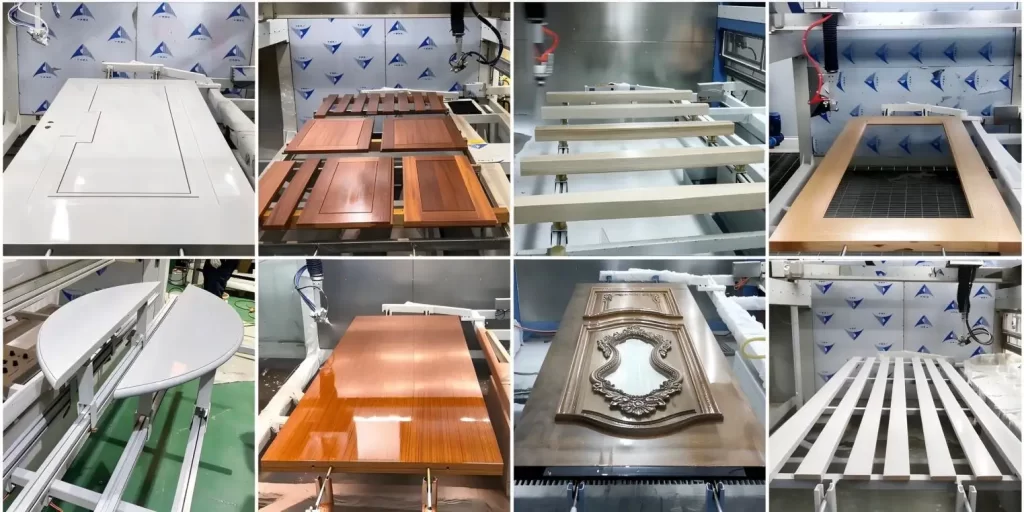
Senlian specifically lists doors, door frames, moldings, wall panels, cabinet doors, tables, and other furniture parts among the applications of its five-axis system, with particular relevance to products with thicker edges.
3. Reducing Shadow Areas
Grooves, recessed panels, and moldings can create areas that a vertically oriented spray pattern does not reach effectively.
Changing the spray direction gives the gun better access to these geometries. A rotating worktable can also present another face or edge to the spray head rather than requiring the head to create every orientation change itself.
Gun Speed, Angle, and Paint Flow Must Work Together
More axes do not solve incorrect spray parameters.
At a constant paint-flow rate, reducing gun speed generally increases paint deposited per unit area. This becomes particularly important at corners, where motion may decelerate.
| Variable | If Incorrect | Possible Result |
| Gun speed | Too slow/fast | Sagging or thin film |
| Paint flow | Too high/low | Runs or poor hiding |
| Spray distance | Excessive variation | Dry spray or heavy deposit |
| Gun angle | Poor surface alignment | Uneven edge coverage |
| Path overlap | Too much/little | Buildup or striping |
| Atomization | Incorrect setting | Texture or excessive rebound |
A useful Furniture Spraying Machine therefore needs both accurate motion control and stable paint delivery.
Why Paint Delivery Matters as Much as Motion
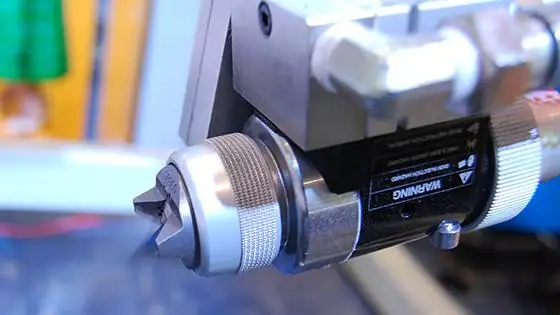
Senlian's standard SL-TSP-W configuration uses a GRACO medium-pressure Air-Mix spray gun supplied by a GRACO Merkur 30:1 plunger pump. The machine also uses independent servo drives, HIWIN linear guides, and an ADTECH motion controller.
Stable pressure matters because a perfectly repeatable path cannot produce a consistent film if coating delivery fluctuates significantly during movement.
Senlian reports that its Air-Mix gun and plunger-pump configuration can reduce paint consumption by approximately 30% compared with the manual spraying methods used in its comparison. This should be treated as a manufacturer-reported result rather than a universal saving; actual consumption depends on part geometry, coating, gun settings, operator baseline, and process conditions.
What Parameters Should Buyers Examine?
The standard Senlian SL-TSP-W provides a useful example of specifications worth checking when comparing a Furniture Spraying Machine.
| Parameter | SL-TSP-W Standard Specification |
| Spray gun speed | 0–1.5 m/s |
| Spray gun angle | 0–20° |
| Maximum workpiece thickness | 100 mm |
| Working size including edges | 400 × 400 to 2200 × 1000 mm |
| Required air pressure | 0.6 MPa |
| Standard power | 3.7 kW, 380 V, 50 Hz, 3P |
| Listed average cycle | 1 process / 2.5 min |
Senlian notes that machine dimensions and parameters can vary with customized configurations.
Cycle time should therefore be verified using the buyer's actual component rather than treated as a guaranteed production rate for every product.
Teach-In Programming or 3D Scanning?
Not every furniture factory needs automatic 3D scanning.
The SL-TSP-W uses a handheld HMI to teach a spray path around an actual component. Once stored, the program can be recalled when the same product returns to production.
This approach fits repeated doors, cabinet panels, frames, and recurring furniture models.
For high-mix production where geometry changes frequently, a scanning-based system may reduce manual path creation. Senlian separately offers a 3D scanning spraying machine for applications requiring automatic geometry recognition before spray-path generation.
The decision is therefore based less on which technology appears more advanced and more on SKU variety, batch size, geometry variation, and programming workload.
Where Can 5-Axis Spraying Still Fail?
A 5-axis Furniture Spraying Machine solves geometry and trajectory problems—not every coating-process problem.
Defects can still result from:
• Incorrect path overlap or corner programming;
• Uncontrolled paint viscosity;
• Excessive paint flow during deceleration;
• Unsuitable atomization settings;
• Poor booth airflow;
• Incorrect flash-off or drying conditions.
This distinction matters during equipment evaluation. More controlled motion cannot compensate for an unstable coating process.
How Should Buyers Verify a Furniture Spraying Machine?
Before purchasing, buyers should test their own representative parts rather than relying only on a machine demonstration.
Evaluate:
• Film consistency across flat areas;
• Front-to-edge transitions;
• Coating inside grooves and profiles;
• Buildup around corners;
• Repeatability across several parts;
• Saved-program recall and product changeover;
• Paint-flow and atomization stability;
• Cleaning and maintenance procedures;
• Actual cycle time with the intended coating.
For stricter finish requirements, wet or dry film thickness, gloss, color difference, and defect rate can also be measured.
Choosing 5-Axis Spraying for Furniture Production
A 5-axis Furniture Spraying Machine makes the strongest technical case when products contain thick edges, recessed or raised profiles, frames, multiple surface angles, or recurring complex geometries.
For factories processing mainly simple flat panels or thin panels, a reciprocating system may still deserve comparison because additional axes introduce programming and system complexity that may not be necessary.
For manufacturers evaluating doors, cabinet panels, frames, or shaped furniture components, Senlian's SL-TSP-W Furniture Spraying Machine provides a practical example of combining servo-controlled multi-axis motion, a rotating worktable, programmable spray paths, and GRACO paint-delivery components in one coating system.
Buyers can review Senlian's 5-axis spray painting machine and discuss actual workpiece dimensions, coating type, geometry, production mix, and required finish before determining the appropriate configuration.
FAQs
Q1. What is Senlian's Furniture Spraying Machine designed for?
It is designed for automated spraying of furniture parts such as doors, cabinet panels, frames, moldings and components with complex edges or profiles.
Q2. Why does Senlian use 5-axis motion for furniture spraying?
Five-axis motion allows the spray gun position, angle and workpiece orientation to be coordinated for flat surfaces, edges and profiled areas.
Q3. What is the spray gun speed of the Senlian SL-TSP-W?
The standard listed spray gun speed is 0–1.5 m/s. Actual settings depend on coating, geometry and required film build.
Q4. What spray gun angle does the machine support?
Senlian lists a spray gun angle range of 0–20° for the standard SL-TSP-W configuration.
Q5. What is the maximum workpiece thickness?
The standard SL-TSP-W lists a maximum workpiece thickness of 100 mm. Custom configurations should be confirmed for specific projects.