



Hot Tags
UV Curing Equipment vs LED UV Curing: Which Technology Fits Your Coating Line?
October 19, 2026


For a coating line, choosing between conventional UV Curing Equipment and LED UV is not simply a choice between an older and a newer light source. The real question is whether the curing spectrum, UV energy, coating chemistry, conveyor speed, and substrate temperature can operate inside the same stable process window.
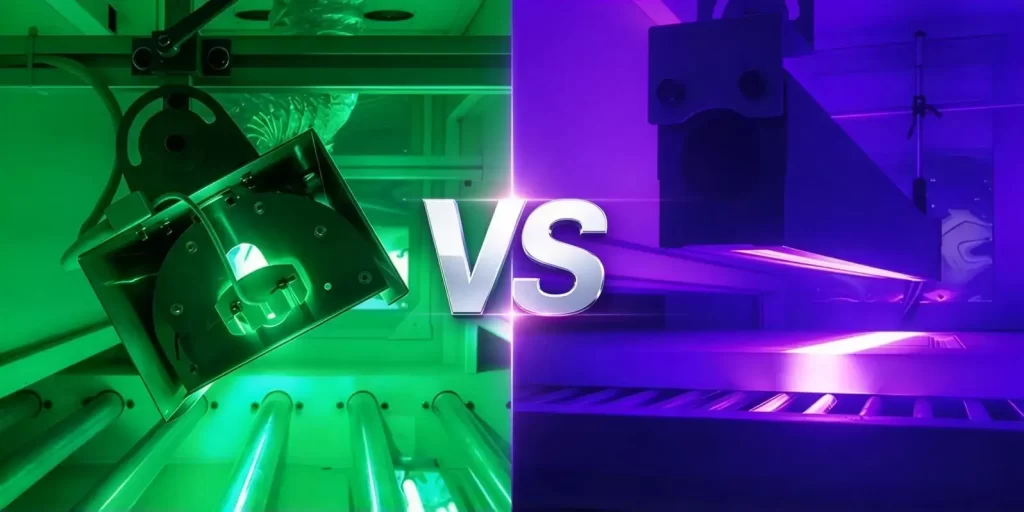
At Senlian, we normally look at the coating process first: What is being coated? Which UV formulation is used? How thick is the film? What line speed is required? Only after these parameters are clear should the UV source be selected.
Start With the Coating Chemistry, Not Lamp Power
UV coatings cure when photoinitiators absorb UV radiation and generate reactive species that initiate polymerization. This makes spectral compatibility fundamental.
Conventional mercury-based UV Curing Equipment provides a relatively broad spectral output. Mercury, gallium, and iron-modified lamps can therefore be selected for formulations with different spectral responses.
UV LED works differently. Its output is concentrated around specific wavelength bands. Successful LED curing therefore depends strongly on whether the coating's photoinitiator system absorbs energy within that band. Senlian identifies spectral output, irradiance, energy density, and LED-compatible chemistry as core parameters when designing a UV LED curing process.
A coating that cures correctly under a mercury lamp should not automatically be assumed to work under LED UV.
UV Curing Equipment vs LED UV: Where the Process Difference Matters
| Process Factor | Conventional UV Curing Equipment | LED UV |
| Spectral output | Broader spectrum | Narrow, wavelength-specific |
| Coating conversion | Often compatible with established UV formulations | Chemistry must be verified |
| Start/stop | Requires lamp operating control | Instant switching |
| Workpiece heat load | Higher thermal load must be managed | Generally lower radiant heat |
| Light-source cooling | Lamp-box ventilation | Water circulation system |
| Best selection basis | Lamp spectrum + coating response | Wavelength + chemistry + dose |
The table is useful, but it should not be used to declare one technology universally superior. A production line with an established pigmented UV coating may require a completely different curing strategy from a coating line using an LED-optimized formulation.
Irradiance and UV Dose Are Not the Same Thing
One common mistake when purchasing UV Curing Equipment is comparing systems only by electrical power.
What matters at the coating surface is the usable UV energy.
Irradiance (W/cm²) describes radiant power reaching the surface.
Energy density or UV dose (J/cm²) describes the accumulated energy received during exposure.
In simplified terms:
UV Dose = Irradiance × Exposure Time
Senlian notes that peak irradiance and energy density must be considered together; simply increasing irradiance does not necessarily produce faster curing.
For conveyorized UV Curing Equipment, exposure time is directly affected by:
•Effective irradiation length;
•Lamp-to-workpiece distance;
•Number and arrangement of curing sections.
This is why a coating that cures correctly at 10 m/min may not remain fully cured after the line speed is increased unless the available process window can support the shorter exposure time.
Why Dark and Pigmented UV Coatings Need Different Lamp Strategies
Pigments can absorb or scatter UV radiation before it penetrates through the complete wet film. As coating opacity and film thickness increase, surface cure and through-cure can behave differently.
For dark or highly pigmented coatings, buyers should examine:
•Pigment type and loading;
•Wet-film thickness;
•Photoinitiator absorption;
•Required surface cure;
•Required through-cure;
•Lamp spectrum;
•Conveyor speed and accumulated UV dose.
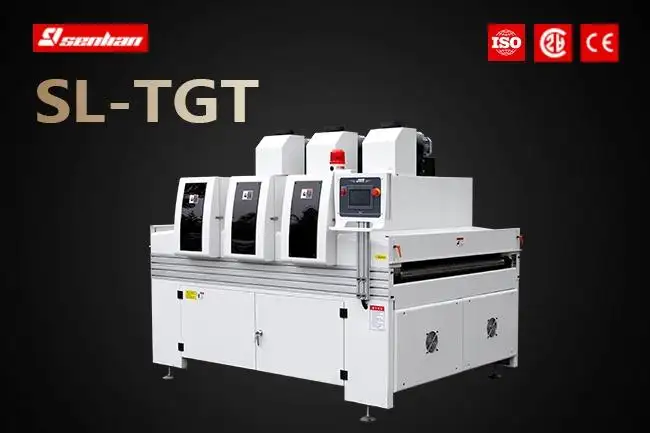
This is one reason Senlian's SL-TGT UV Curing Equipment uses three independent irradiation sections rather than treating every coating with one fixed source. Mercury, gallium, or iron lamps can be selected according to the UV formulation, and Senlian specifies the machine for clear, colored, and dark-color UV coatings.
The purpose of multiple lamp options is not simply to add more power. It is to provide more flexibility when matching the irradiation system to coating response.
Heat Management Is a Process Parameter
Conventional UV Curing Equipment generates heat around the lamp chamber and workpiece. If that heat is not controlled, temperature-sensitive substrates can deform, coating viscosity can change, and lamp output stability can be affected.
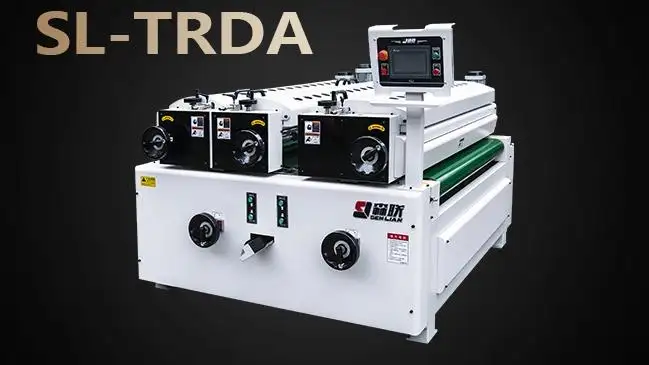
The Senlian SL-TGT addresses this with three independent top-mounted cooling fans, controlled by the machine system to remove heat from each lamp chamber.
LED UV reduces radiant heat reaching the substrate, which can make it attractive for PVC, PET, thin boards, or other heat-sensitive products. However, LED does not eliminate cooling requirements: the LED modules themselves still require thermal management. Senlian's LED UV system therefore uses a circulating water-cooling system.
So the engineering question is not simply "Which technology runs cooler?" It is:
Can the curing system maintain both the substrate and the light source inside their acceptable temperature range at production speed?
Senlian UV Curing Equipment for Continuous Coating Lines
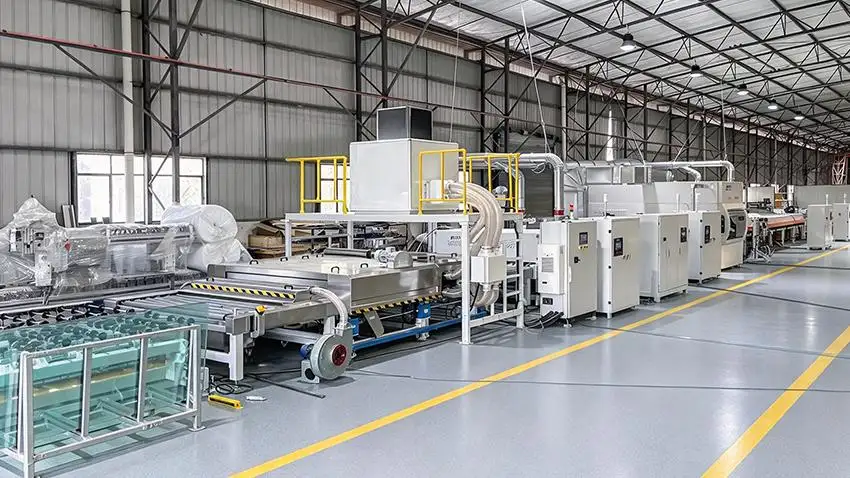
The SL-TGT is designed as a curing section within continuous roller or curtain coating processes rather than as an isolated UV lamp cabinet.
Standard configurations include:
| Model | Max. Processing Width | Full Power |
| TGT600 | 580 mm | 19.8 / 21.4 kW |
| TGT800 | 780 mm | 19.8 / 21.4 kW |
| TGT1300 | 1280 mm | 31.8 / 33.2 kW |
The machine combines three lamp sections, frequency-controlled steel roller conveying, HMI control, independent cooling, and accessible flip-open lamp housings. Senlian states a curing time of approximately 3–5 seconds for compatible UV coatings under suitable process conditions.
That curing time should not be interpreted as a universal specification for every coating. Actual results still depend on formulation, thickness, color, UV dose, and line speed.
What Should Buyers Test Before Selecting UV Curing Equipment?
A useful curing trial should reproduce production conditions rather than test only whether the coating "feels dry."
Before specifying UV Curing Equipment, verify:
•Actual substrate and surface condition;
•Coating formulation and supplier data;
•Clear, colored, white, or dark coating;
•Target wet/dry film thickness;
•Production conveyor speed;
•Lamp type or LED wavelength;
•Irradiance and UV dose at the workpiece;
•Substrate temperature;
•Tack-free condition and surface hardness;
•Adhesion and through-cure;
•Curing uniformity across the complete working width.
Also compare total operating cost rather than electricity alone. Lamp replacement, cooling, maintenance, downtime, coating reformulation, and qualification work can materially affect the economics of a mercury-to-LED conversion.
Choose UV Curing Equipment Around the Process Window
A reliable selection sequence is:
Coating Chemistry → Spectral Response → Film Thickness And Color → Irradiance And Dose → Line Speed → Thermal Limit → Cooling → Curing Verification.
For manufacturers building or upgrading a roller or curtain coating line, Senlian can configure UV Curing Equipment around different processing widths, conveyor requirements, UV lamp arrangements, and coating conditions. Providing actual substrate samples, coating information, target film thickness, working width, and production speed gives the engineering team a much stronger basis for defining the curing section than selecting equipment from lamp power alone.
For more technical information on Senlian's SL-TGT UV curing machine, review the current UV Curing Equipment configuration and discuss your coating process with Senlian before finalizing the lamp combination.
FAQs
Q1. What types of coatings can Senlian UV Curing Equipment cure?
Senlian SL-TGT UV Curing Equipment is designed for clear UV, colored UV, and dark-color UV coatings.
Q2. What UV lamps can be used in Senlian UV Curing Equipment?
Senlian can configure mercury, gallium, or iron UV lamps according to coating color and curing requirements.
Q3. How many UV lamps does the Senlian SL-TGT use?
The SL-TGT uses three UV lamp sections, allowing the curing configuration to be matched to different coating processes. Senlian also offers single-lamp, double-lamp, four-lamp, and five-lamp models.
Q4. What working widths are available for Senlian UV Curing Equipment?
Standard maximum processing widths are 580 mm, 780 mm, and 1280 mm for the TGT600, TGT800, and TGT1300 models. Other processing widths can be customized; currently, the maximum processing width that Senlian can provide is 3300mm.
Q5. What materials can Senlian UV Curing Equipment process?
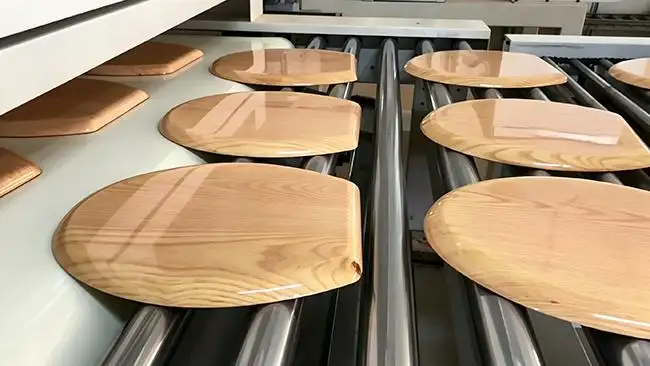
Applications include wood, MDF, plywood, veneer, PVC, PET, glass, metal, fiber cement board, ceramics, marble, and other flat or shaped materials.