



Hot Tags
Glass Coating Machine for Flat Glass: Key Parameters for Uniform Film Thickness
October 21, 2026


For Senlian, uniform coating on flat glass is not simply a question of setting a roller gap and starting production. A Glass Coating Machine for Flat Glass must maintain a stable coating process while viscosity, glass dimensions, line speed, coating temperature, roller condition, and drying load change during continuous operation.
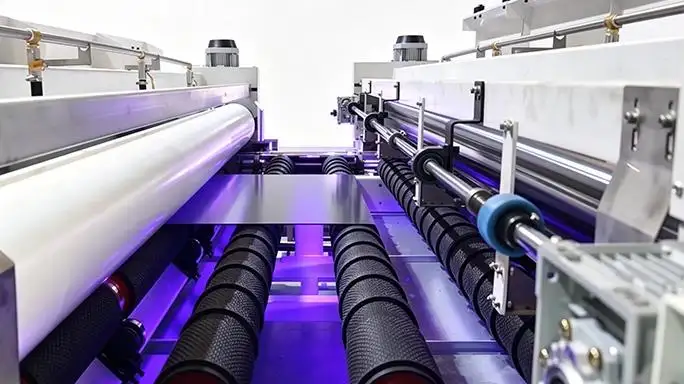
The real target is not one acceptable sample. It is a repeatable process window that keeps coating weight and surface quality consistent across the glass width, along the conveying direction, and from batch to batch.
Where Does Coating Thickness Variation Come From?
Thickness variation normally appears in two directions:
• Cross-web variation: left-center-right differences across the glass width.
• Machine-direction variation: leading-middle-trailing differences as the glass moves through the line.
These patterns point to different root causes.
| Thickness Pattern | Typical Variables to Check |
| One side consistently heavier | Roller parallelism, glass flatness, coating distribution |
| Periodic bands | Roller runout, surface condition, drive stability |
| Gradual thickness drift | Viscosity, temperature, coating circulation |
| Front-to-back variation | Conveyor speed, coating delivery stability |
| Uniform wet film but uneven final film | Drying temperature, airflow, curing condition |
A professional Glass Coating Machine for Flat Glass therefore needs control over both mechanical accuracy and coating-process stability.
Film Thickness Is a Result of Several Interacting Variables
For practical process engineering, final film formation can be viewed as:
Metered Coating → Coating Transfer → Wet-Film Leveling → Solvent/Water Removal → Final Dry Film
The main control variables include:
• Coating viscosity and solids content;
• Coating temperature;
• Metering gap;
• Application and doctor roller speeds;
• Conveyor speed;
• Glass flatness and thickness tolerance;
• Coating circulation;
• Drying temperature and residence time.
Changing one parameter can alter the effect of another. For example, the same roller gap may produce a different coating weight if viscosity or roller-speed ratio changes.
This is why copying machine settings from one coating formulation to another rarely gives identical results.
How Does Roller Coating Control Thickness?
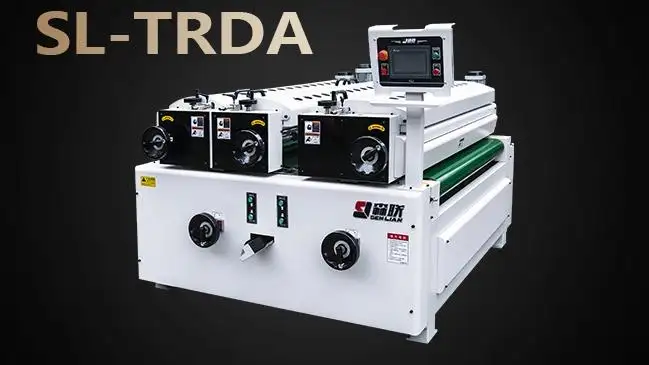
Senlian's roller coating system uses a rubber application roller and doctor steel roller, with liquid coating pumped into the coating section and returned through a circulation system. Individual drive sections use frequency-conversion control, allowing roller and conveying conditions to be adjusted for the process.
1. Metering Gap
The doctor/application roller relationship controls how much coating is carried into the transfer zone.
A smaller gap may reduce coating volume, but gap alone does not determine dry-film thickness.
2. Roller Speed Ratio
The surface-speed relationship between rollers changes:
• Coating shear;
• Metering behavior;
• Liquid-film formation;
• Transfer to the glass.
For fine adjustment, speed ratio can therefore be as important as mechanical gap.
3. Roller Geometry and Parallelism
For large-format glass, small alignment errors become more significant across the working width. Roller runout, surface wear, contamination, or incorrect parallelism can create repeatable thickness bands.
Senlian positions precision roller coating particularly for large-format flat glass and functional or decorative coatings where controlled transfer and coating utilization are important.
Why Must Viscosity and Temperature Be Managed Together?
Coating viscosity is not fixed during production.
As coating temperature changes, flow behavior can change, which affects:
Metering → Transfer → Leveling → Final Coating Weight
A Glass Coating Machine for Flat Glass should therefore be operated within a defined viscosity window rather than relying only on machine settings.
Operators should record:
• Coating batch;
• Viscosity measurement method;
• Coating temperature;
• Dilution ratio, where applicable;
• Solids content where relevant;
• Time since coating preparation.
This becomes especially important when comparing production data between shifts.
Roller Coating or Spray Coating?
Senlian works with both precision roller coating and automated glass spray coating, so the process should be selected from the coating requirement rather than from machine preference.
| Decision Factor | Roller Coating | Spray Coating |
| Large regular flat panels | Strong fit | Suitable |
| Film metering | Roller/gap/speed controlled | Flow/atomization controlled |
| Curved or irregular glass | Limited | Better suited |
| Edge coverage | Limited | More flexible |
| Main process risks | Gap, roller condition, viscosity | Atomization, overlap, overspray |
For standard flat surfaces, roller coating offers direct mechanical control of coating transfer. Spray coating becomes more useful where geometry, edge coverage, or coating characteristics require greater application flexibility.
Glass Preparation Cannot Be Separated From Coating Quality
Even a well-adjusted Glass Coating Machine for Flat Glass cannot compensate for a poorly prepared substrate.
Dust, oil, fingerprints, polishing residue, or residual moisture may cause:
• Poor wetting;
• Fisheyes;
• Pinholes;
• Local adhesion loss;
• Visual thickness variation.
A production line should therefore be evaluated as:
Washing → Drying → Inspection → Coating → Drying/Curing → Cooling
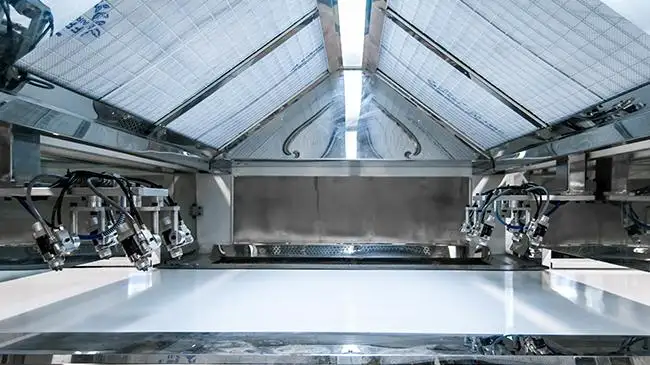
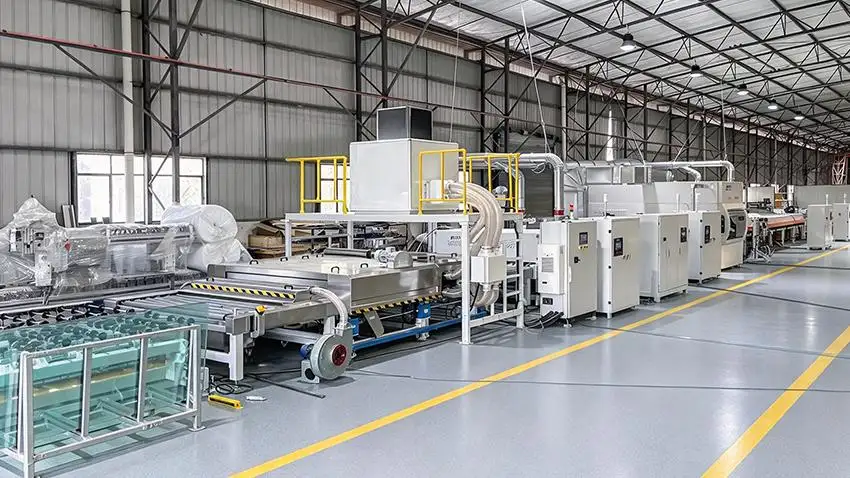
Senlian's automated glass spray line integrates glass washing, coating, drying, and cooling in one production sequence, illustrating why coating quality must be considered as a line-level problem.
Why Can Drying Destroy a Uniform Wet Film?
Wet-film uniformity does not guarantee dry-film uniformity.
Uneven heating or airflow can change evaporation rates across the glass. Process engineers should therefore check:
• Oven-zone temperature;
• Airflow distribution;
• Conveyor speed;
• Residence time;
• Coating formulation;
• Glass thermal load.
When coating weight appears correct before drying but finished panels show visual differences, the root cause may be downstream of the Glass Coating Machine for Flat Glass itself.
Use Thickness Mapping, Not a Single Measurement
A useful production check should cover both directions of the panel:
| Left | Center | Right | |
| Leading edge | ● | ● | ● |
| Middle | ● | ● | ● |
| Trailing edge | ● | ● | ● |
This nine-point concept immediately shows whether variation is cross-web, machine-directional, or localized.
The measurement report should also identify:
• Glass size;
• Coating batch;
• Line speed;
• Viscosity/temperature condition;
• Measurement method;
• Wet or dry-film basis.
Without this context, a quoted "coating tolerance" has limited engineering value.
What Should Be Verified Before Buying a Glass Coating Machine for Flat Glass?
A realistic process trial should use conditions close to actual production—not only a small demonstration sample.
Buyers should provide:
• Minimum, typical, and maximum glass sizes;
• Glass thickness and flatness requirements;
• Actual or representative coating;
• Target coating weight or film thickness;
• Viscosity/process range;
• Required production speed;
• Drying or curing method.
During PAT or process validation, check repeated panels and continuous operation rather than only the first acceptable piece.
Ask the supplier:
• How is roller parallelism verified?
• How are roller and conveyor speeds synchronized?
• How is coating circulated?
• How is thickness mapped across wide glass?
• How are drying conditions validated?
• Can the process be tested with the customer's actual coating?
• From Machine Specification to a Stable Coating Process
Selecting a Glass Coating Machine for Flat Glass should begin with the required finished coating and work backward to machine configuration.
At Senlian, this may involve precision roller coating for regular flat substrates, spray coating for applications requiring flexible coverage, or an integrated line combining preparation, application, drying, and conveying. Senlian also operates a coating laboratory for material analysis, coating-performance testing, parameter adjustment, and coating-solution validation before equipment configuration.
For a new flat-glass project, manufacturers can provide Senlian with the glass dimensions, coating formulation, target film requirement, production speed, and curing conditions. These process inputs give a more reliable basis for selecting and validating a Glass Coating Machine for Flat Glass than nominal machine specifications alone.
FAQs
Q1. What type of Glass Coating Machine for Flat Glass does Senlian provide?
Senlian provides precision roller coating, curtain coating, automatic spray coating, and integrated coating-line solutions for flat glass applications.
Q2. Can Senlian help control coating thickness on large flat glass?
Yes. Senlian combines key roller-manufacturing parameters, roller-gap adjustment, roller-speed control, coating circulation, conveying control, and process testing to support stable coating results.
Q3. Does Senlian use roller coating for flat glass?
Yes. Precision roller coating is suitable for regular flat-glass surfaces where controlled coating transfer and consistent film formation are required.
Q4. When would Senlian recommend spray coating instead of roller coating?
Spray coating may be more suitable when glass geometry, edge coverage, coating characteristics, or application flexibility make roller transfer less appropriate.
Q5. Can Senlian test a customer's coating before machine configuration?
Senlian can evaluate coating materials, process parameters, and application requirements before final equipment configuration.