



Hot Tags
How Roller Speed Ratio Affects an Automatic Glass Coating Machine
October 21, 2026


In an Automatic Glass Coating Machine, roller speed is not simply a production-speed setting. The surface-speed relationship between the metering roller, applicator roller, and moving glass changes shear, liquid metering, and transfer at the nip. Two runs using the same coating, roller gap, and substrate can therefore produce different wet-film thicknesses.
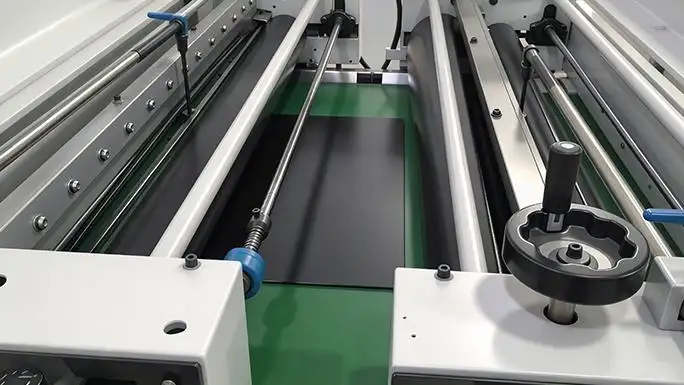
The useful engineering question is not "What RPM should the roller run at?" but "What speed relationship creates a stable coating window?"
1. Roller RPM Is Not Surface Speed
Roller surface speed depends on diameter and rotational speed:
V = πDN
where:
•V = roller surface speed
•D = roller diameter
•N = rotational speed
If two rollers have different diameters, identical RPM values do not produce identical surface speeds. An Automatic Glass Coating Machine should therefore be evaluated in surface speed, normally m/min, rather than RPM alone.
A roller-to-roller ratio can be expressed as:
R = Vm / Va
where Vm is metering-roll surface speed and Va is applicator-roll surface speed. The ratio definition should always be stated because coating references do not use one universal convention.
2. How Roller Speed Ratio Changes Coating Transfer
At the coating nip, liquid behavior is governed by:
•Viscous drag;
•Nip pressure;
•Surface tension;
•Relative shear;
•Coating rheology.
Changing relative roller velocity changes how much liquid is metered and transferred toward the substrate.
Speed Ratio → Relative Shear → Metered Liquid Layer → Transfer → Wet-Film Thickness
Reverse-roll coating research shows that stable film formation depends on speed ratio together with roller gap and fluid rheology rather than speed ratio alone.
Does a Higher Speed Ratio Always Produce a Thinner Film?
No.
In some reverse-roll conditions, increased relative motion produces stronger wiping and reduces transferred coating. However, the result also depends on:
•Forward or reverse rotation;
•Roller gap;
•Viscosity and shear-thinning behavior;
•Roller hardness;
•Coating feed condition;
•Applicator-to-glass speed differential.
An Automatic Glass Coating Machine should therefore be optimized through a process window, not one fixed "ideal" ratio.
3. Speed Ratio, Gap, and Viscosity Work Together
Film thickness is the result of several interacting variables.
| Process Variable | Primary Effect | Risk When Incorrect |
| Roller speed ratio | Changes shear and metering | streaking, unstable transfer |
| Roller gap | Controls liquid passage | starvation or excessive coating |
| Coating viscosity | Controls flow resistance | poor transfer or leveling |
| Conveyor speed | Changes roller/glass relative motion | film-weight variation |
| Roller runout | Changes effective nip geometry | periodic thickness variation |
Rheology is particularly important. A shear-thinning coating can show lower apparent viscosity as shear rate increases. Increasing roller speed may therefore change both mechanical wiping and the effective flow behavior of the coating. Studies of non-Newtonian reverse roll coating confirm that speed ratio, gap, and rheology interact in determining transferred film thickness.
4. Match Roller Speed to Glass Conveyor Speed
For flat glass, applicator speed must also be compared with glass travel speed.
| Roller-to-Glass Condition | Relative Shear | Typical Effect |
| Near-matched speed | Low | gentler coating transfer |
| Moderate differential | Medium | controlled transfer and metering |
| Large differential | High | stronger wiping and higher instability risk |
A large speed differential may increase wiping but can also contribute to streaks, bead instability, or insufficient transfer.
For an Automatic Glass Coating Machine, roller speed and conveyor speed should therefore be validated as one parameter set.
5. Forward and Reverse Rotation Are Different from Speed Ratio
Roll direction determines the direction of relative movement. Speed ratio determines the magnitude of that movement.
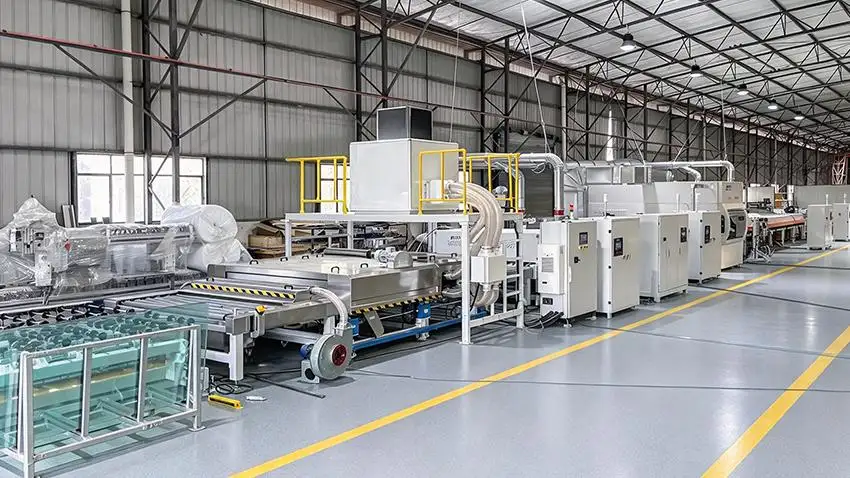
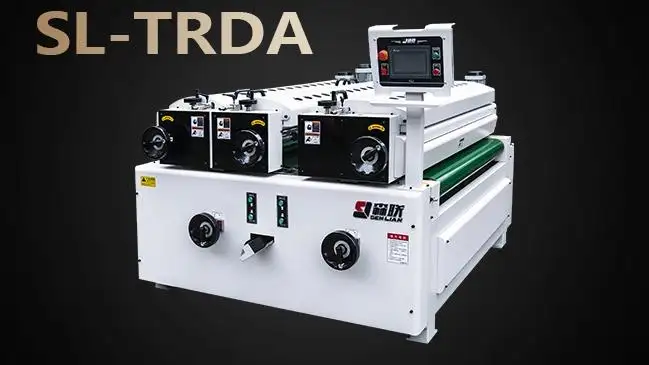
Senlian's SL-TRDA double roll coating machine combines forward- and reverse-rotating roller structures. Senlian describes forward rotation as suitable for lighter coating application, while reverse operation increases material transfer for thicker-film requirements.
Its coating section includes:
•Two EPDM rubber rollers;
•Three chrome-plated stainless-steel rollers;
•Mechanical coating-gap adjustment;
•Precision bearings;
•Ball-screw and worm-gear positioning.
The real process relationship is therefore:
Roll Direction + Surface Speed + Gap + Coating Rheology
—not roller direction alone.
6. Use Coating Defects to Diagnose the Process Window
When speed ratio, gap, or rheology moves outside a stable operating range, an Automatic Glass Coating Machine may show:
•Longitudinal streaks or ribbing;
•Roller marks;
•Unstable coating bead;
•Edge build-up;
•Uneven wet-film thickness;
•Poor leveling;
•Incomplete material transfer.
The troubleshooting principle is simple: change one variable at a time.
Keep coating batch, temperature, substrate, gap, and conveyor speed fixed, then adjust the selected roller speed. Otherwise, it becomes difficult to identify whether the defect originates from speed ratio, viscosity, gap, or substrate transfer.
7. Mechanical Accuracy Determines Whether the Ratio Is Repeatable
A programmed speed ratio is useful only if the physical nip remains stable.
Roller runout, bearing play, lifting deviation, or alignment error changes the effective coating gap even when motor speed remains constant.
For the SL-TRDA, Senlian specifies roller surface runout of ≤0.008 mm. The machine also uses precision bearings, rigid dovetail and linear-guide lifting structures, and independent motor reducers for separate transmission sections.
This is important because repeatability in an Automatic Glass Coating Machine requires two conditions:
Stable Roller Speed + Stable Nip Geometry
HMI-based parameter control and closed-loop coating circulation are also used on the SL-TRDA to support consistent machine operation and coating supply.
8. Establishing The Right Roller Speed Ratio
The following is a suggested procedure for a production trial:
- Set gap, type of glass, coating-batch, temperature, viscosity, and the speed of the conveyor.
- Record the actual surface speed of the rollers. (Included is a note of the speed of rotation of the rollers.)
- Establish one speed ratio.
- Alter one of the roller speeds.
- Measure the wet film thickness or weight of coating.
- Look for defects of coating, and leveling.
- Evaluate the appearance, adhesion, dry film thickness, and other performance traits of the coating.
The objective is not maximum roller speed. It is a repeatable operating window that continuously meets coating specifications.
Selecting an Automatic Glass Coating Machine
When evaluating an Automatic Glass Coating Machine, buyers should verify more than maximum working speed. Important questions include:
•Can roller direction be changed for different coating requirements?
•How is coating gap positioned and repeated?
•Can individual drive sections maintain stable speed and torque?
•How is roller alignment controlled?
•Can roller materials be matched to the coating system?
•Can conveyor layout be adapted to the glass dimensions?
•Can the machine integrate with leveling, drying, or UV curing?
Senlian's SL-TRDA is designed for flat substrates including glass and is listed for UV, PU, PE, NC, AC, water-based, fluorocarbon, adhesive, and other liquid coatings. Standard configurations use forward/reverse coating structures, independent drive sections, closed-loop coating circulation, and customizable roller materials and conveyor arrangements.
For a new glass coating project, the more useful starting data are glass dimensions, coating chemistry, viscosity range, target wet/dry film thickness, required line speed, and curing method. Senlian can then evaluate the Automatic Glass Coating Machine configuration around the actual coating process rather than forcing production into a generic roller-speed setting.
FAQs
Q1. Can Senlian's double roll coating machine be used for glass?
Yes. Senlian lists glass among the flat substrates supported by its SL-TRDA double roll coating machine.
Q2. Can Senlian's machine switch between forward and reverse roll coating?
Yes. The SL-TRDA combines forward- and reverse-rotating coating structures, allowing operators to change the coating mode according to film requirements.
Q3. How does Senlian adjust coating thickness?
Coating thickness is controlled through roller interaction, rotation direction, and mechanical roller-gap adjustment using a ball screw and worm gear reducer.
Q4. What roller materials are used in Senlian's double roll coating machine?
The coating section uses two EPDM rubber rollers and three chrome-plated stainless-steel rollers.
Q5. What is the roller runout specification?
Senlian specifies roller surface runout of ≤0.008 mm for the SL-TRDA double roller structure.