



Hot Tags
How to Select a UV Drying Tunnel for Wood, MDF and Furniture Coating Lines
October 20, 2026


Selecting a UV Drying Tunnel for wood or MDF should start with the coating system, not with lamp wattage.
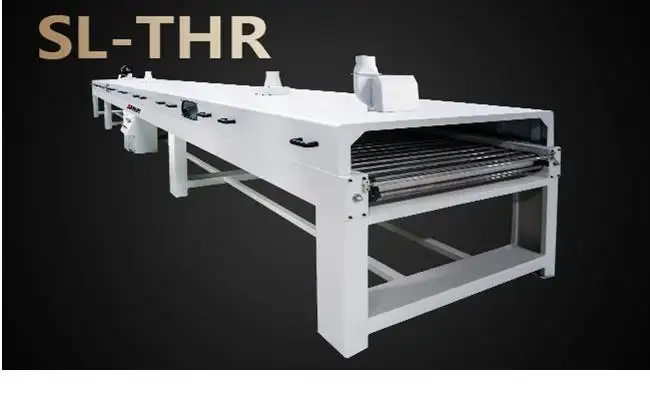
Two furniture lines processing the same 1,220 mm panel may require different curing configurations because coating chemistry, pigment, film thickness, conveyor speed and substrate temperature all affect the curing window.
For buyers, the practical selection chain is:
Substrate → Coating Chemistry → UV Spectrum → UV Dose → Line Speed → Working Width → Thermal Load → Pre-Drying → Verification
1. Confirm Whether the Coating Actually Needs UV Curing
A UV Drying Tunnel does not dry every coating by the same mechanism. UV coatings cure through photochemical polymerization, while water-based and many conventional coatings must first remove water or volatile components.
| Coating Process | Main Requirement | Typical Equipment |
| UV coating | Photochemical curing | UV Drying Tunnel |
| LED-compatible UV coating | Wavelength-specific curing | LED UV |
| Water-based coating | Moisture evaporation | Hot-air oven |
| PU, PE, NC or AC coating | Formulation-dependent drying | Thermal/process-specific drying |
| Hybrid system | Evaporation + UV cure | Hot air + UV |
This distinction matters in furniture lines. Adding more UV energy will not solve a moisture-removal problem.
Senlian's Hot Air Drying Oven, for example, is designed for coatings including water-based paint, PU, PE, NC and AC. Heated air passes across the coating through air knives while circulation and exhaust paths remove moisture and VOC-containing air.
2. Match the UV Spectrum to the Coating
Higher lamp power does not automatically mean better curing.
The photoinitiators in a UV formulation must absorb wavelengths emitted by the selected lamp. Clear, pigmented and dark coatings can therefore require different irradiation strategies.
Senlian's UV curing equipment can be configured with mercury, gallium or iron lamp sources according to the UV formulation and uses three independent lamp sections. It is specified for UV-coated materials including wood, veneer, MDF, particleboard and plywood.
Before selecting a UV Drying Tunnel, buyers should ask:
• What UV wavelength range does the coating require?
• Is the coating clear, colored or highly pigmented?
• Does the specification require surface cure, through-cure or both?
• What film thickness will actually run in production?
A coating can remain under-cured even under a powerful lamp if its spectral response is mismatched.
3. Balance UV Dose With Conveyor Speed
One of the most important UV Drying Tunnel variables is the relationship between irradiance and exposure time.
In practical terms:
UV dose ≈ UV intensity × Exposure time
Increasing conveyor speed reduces the time that each panel remains inside the irradiation zone. If other parameters remain unchanged, the delivered dose may become insufficient.
Running too slowly is not automatically safer either. Excessive exposure can increase panel temperature, disrupt production balance or expose heat-sensitive substrates to unnecessary thermal load.
During equipment trials, verify the combination of:
| Parameter | What to Check |
| Irradiance | Energy reaching the panel surface |
| UV dose | Required energy for the coating |
| Conveyor speed | Target production speed |
| Lamp distance | Effect on radiation intensity |
| Film thickness | Through-cure requirement |
| Panel temperature | Thermal exposure |
4. Size the Tunnel for the Actual Panel
Do not select working width from the nominal board dimension alone.
The required width should consider:
Maximum Product Width + Positioning Tolerance + Conveyor Clearance
For reference, Senlian lists conventional UV curing models with maximum processing widths of 580 mm, 780 mm and 1,280 mm, while custom sizes are also available.
For a nominal 1,220 mm MDF board, the important question is therefore not simply whether the machine exceeds 1,220 mm, but whether the complete conveyor system provides sufficient operating clearance and stable positioning.
5. Consider MDF, Veneer and Solid Wood Separately
Prior to entering the UV Drying Tunnel, how substrate properties effect coating behavior is of interest.
• MDF: Sealing and primer control may be needed due to absorbent, open-pored surface.
• Veneer: Even temperature throughout is essential.
• Solid Wood: Weight loss due to moisture loss may lead to dimensional changes.
• Particle Board and Plywood: Coating behavior is influenced by surface structure.
If primer penetration or coating distribution is poor, increasing UV lamp output will not correct the underlying surface-preparation problem.
6. Evaluate Thermal Load and LED UV Options
Conventional UV and LED UV should be selected according to coating compatibility, not simply according to which technology is newer.
Senlian's LED UV equipment uses dedicated LED UV lamps with a circulating water-cooling system and is specified for specialized UV coatings on wood, veneer, MDF, particleboard and plywood.
LED UV can be useful where lower thermal loading is important, but the coating must contain a photoinitiator system compatible with the LED wavelength.
7. Decide Whether Hot-Air Pre-Drying Is Required
Many furniture finishing lines require more than a standalone UV Drying Tunnel.
A hybrid process may look like:
Coating → Flash-off → Hot-Air Drying → UV Curing → Cooling/Inspection
Hot-air pre-drying becomes relevant when the coating needs moisture or volatile components removed before final curing.
Senlian's Hot Air Drying Oven uses internal air knives, circulation fans, return-air ducts and exhaust airflow. Its oven length can be configured according to coating condition, required drying state and production speed; increasing conveyor speed reduces residence time in the heated zone.
This leads to an important engineering rule:
Do not try to solve an evaporation problem by simply increasing UV power.
8. Treat the UV Drying Tunnel as Part of the Complete Line
A furniture coating line might include:
Sanding → Dust Removal → Primer → Roller/Curtain/Spray Coating → Pre-Drying → UV Drying Tunnel → Sanding → Topcoat → Final Cure
Each section must operate at a compatible throughput.
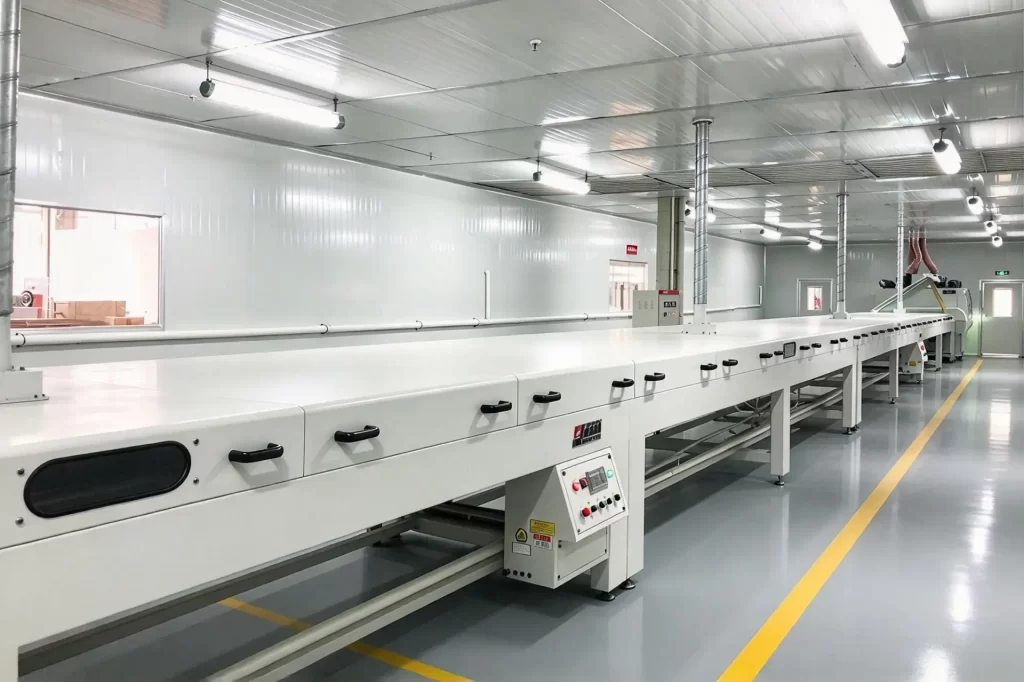
If the coating machine runs faster than the curing section can handle, the UV Drying Tunnel becomes the bottleneck. If the drying tunnel requires a longer residence time, its length must be considered when planning floor space and conveyor layout.
9. Verify the Process With Real Samples
Before final equipment selection, test the proposed configuration using the real:
• Substrate
• Coating Formulation
• Film Thickness
• Panel Dimensions
• Production Speed
Evaluate surface tack, adhesion, hardness, abrasion resistance, gloss, color consistency, edge curing and panel temperature.
The key purchasing question is not whether a supplier can cure a sample at a very slow demonstration speed. It is whether the required finish can be reproduced at the planned production rate.
Select the Process Before Selecting the Machine
A reliable UV Drying Tunnel specification should come from coating chemistry and production conditions rather than nominal lamp power alone. Buyers should define the substrate, coating, film build, panel size and line speed first, then determine spectrum, UV dose, cooling, conveyor arrangement and any required pre-drying stage.
For projects where moisture removal or intermediate drying is required before UV curing, Senlian's Hot Air Drying Oven can be integrated into continuous coating lines and configured around oven length, heating method and conveying requirements. Senlian also provides UV, LED UV and other drying/curing equipment, allowing manufacturers to evaluate the drying and curing stages as one coordinated finishing process rather than purchasing isolated machines.
FAQs
Q1. What materials can Senlian UV curing equipment process?
Senlian UV curing systems are designed for coated materials such as wood, MDF, veneer, plywood, particleboard, and fireproof board, depending on the coating process.
Q2. Can Senlian provide a UV Drying Tunnel for MDF coating lines?
Yes. Senlian offers UV curing equipment that can be integrated into MDF and panel coating lines according to product width, coating type and production speed.
Q3. How does Senlian determine the required UV lamp configuration?
The configuration should be selected according to coating chemistry, color, photoinitiator response, film thickness and target conveyor speed.
Q4. Does Senlian offer different UV lamp types?
Senlian UV curing equipment can use different lamp configurations, including mercury, gallium and iron lamps, depending on the UV coating requirement.
Q5. Can Senlian integrate hot-air drying before a UV Drying Tunnel?
Yes. A hot-air drying stage can be used when coatings require moisture or volatile components to be removed before UV curing.