



Hot Tags
Wood Coating Line Guide: How UV Roller Coating Automates Furniture Finishing
October 20, 2026


Furniture factories often automate cutting, CNC machining and edge processing before they automate finishing. The result is a familiar bottleneck: panels move quickly through machining, then wait for sanding, coating, leveling and drying.
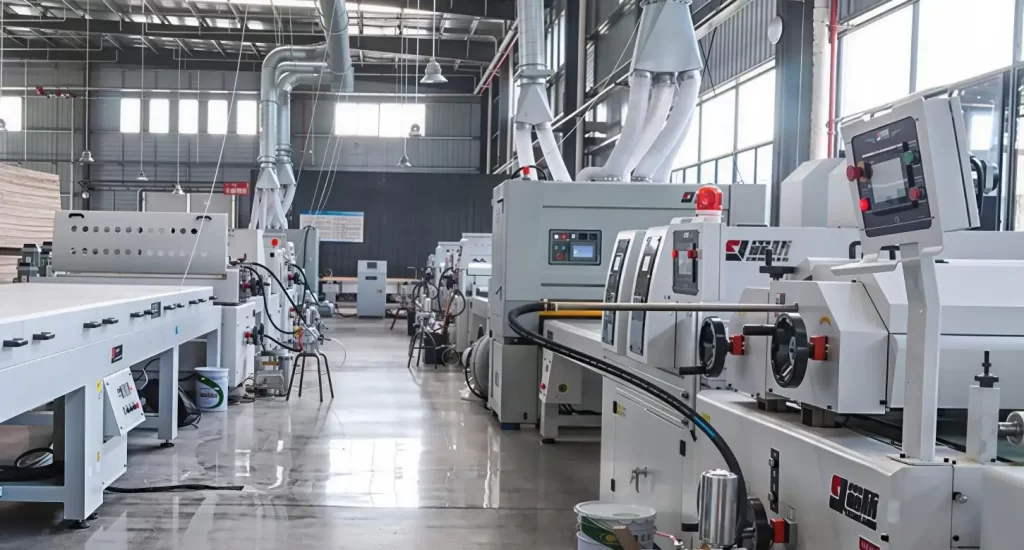
A modern Wood Coating Line changes this workflow by connecting these stages into a controlled process. For flat furniture panels, UV roller coating is especially suitable because coating transfer, conveyor speed and curing conditions can be set as measurable production parameters rather than depending mainly on operator technique.
What Does Automation Change in a Wood Coating Line?
Automation does not automatically produce a better surface. Its main value is reducing uncontrolled variation.
Manual spraying can change with gun distance, spraying angle, operator speed and paint adjustment. An automated Wood Coating Line instead controls variables such as:
•Conveyor speed;
•Roller gap and pressure;
•Application and doctor roller speed;
•Coating viscosity;
•Coating amount;
•Leveling conditions;
•UV exposure.
The objective is to move from operator-controlled coating to parameter-controlled coating.
A typical automated process may include:
Loading → Sanding → Dust Removal → Primer Sanding → Topcoat → Leveling→ Roller Coating → UV Curing → Final Curing → Film Application/Stacking
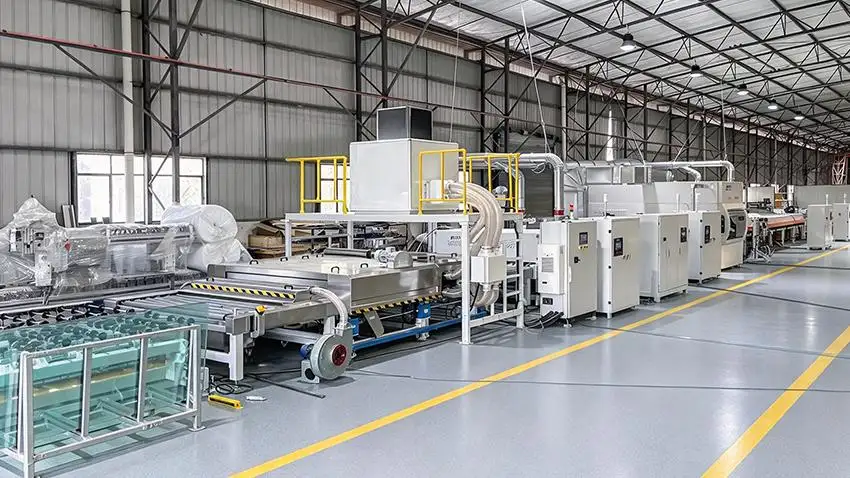
Senlian's UV Roller Coating Line follows this type of integrated structure, combining surface treatment, roller coating, UV leveling, UV curing and downstream material handling.
Why UV Roller Coating Fits Furniture Production
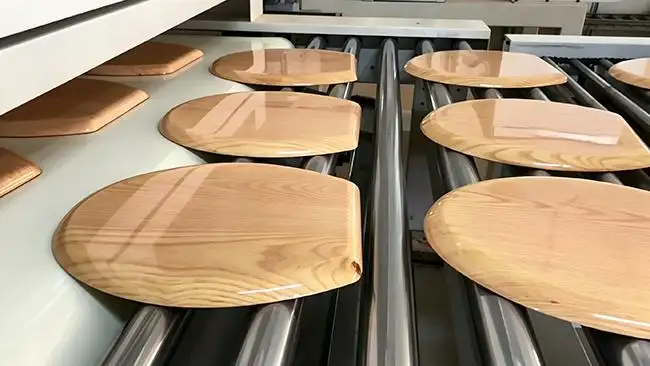
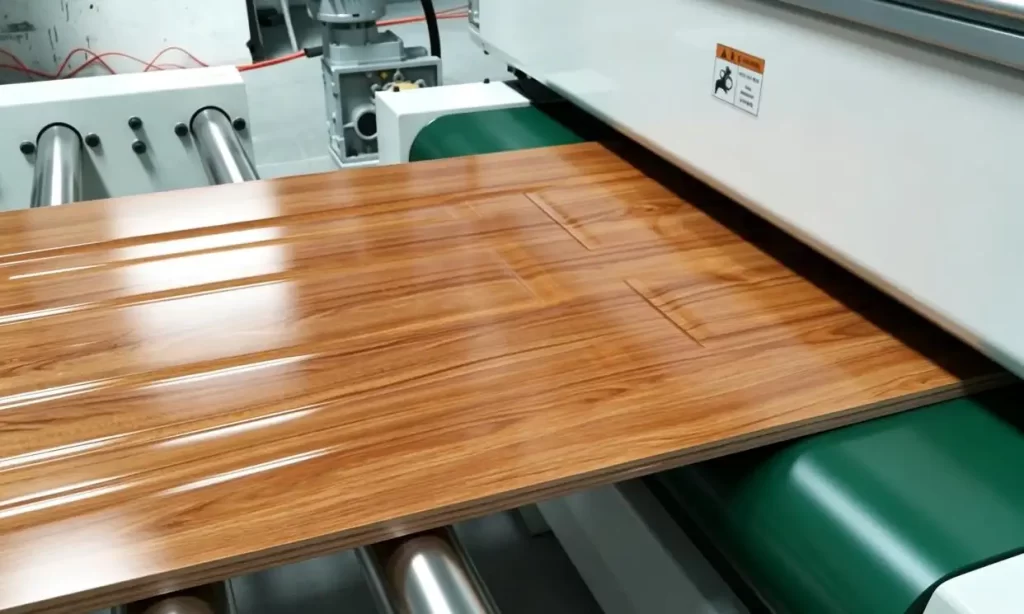
For flat MDF, veneer, flooring and furniture panels, roller coating provides controlled contact between the coating roller and workpiece.
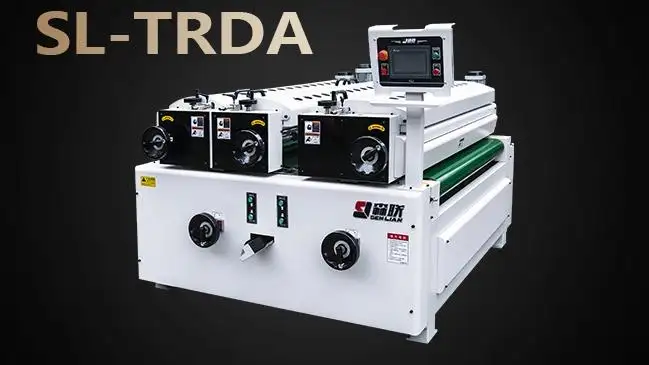
In Senlian's system, a doctor steel roller controls paint supply while a rubber application roller transfers the coating to the panel surface.
Several parameters affect the resulting film:
•Roller gap;
•Roller direction and speed;
•Rubber hardness;
•Coating viscosity;
•Conveyor speed;
•Substrate absorption;
•Target film build.
This makes a roller-based Wood Coating Line particularly useful where repeatable coating weight and uniform flat-panel finishing are required.
It is less suitable for every geometry. Deep grooves, routed profiles and complex three-dimensional parts may still require spray coating because atomized paint can reach areas that a roller cannot contact effectively. Senlian likewise positions roller coating mainly for flat or shallow-profile wood products and spray coating for more complex shapes.
Line Speed, Film Thickness and UV Energy Must Be Matched
Increasing conveyor speed alone does not guarantee higher usable output.
The relationship is straightforward:
Higher line speed → Shorter UV exposure time
At the same time:
Greater film thickness → Greater curing demand
If the Wood Coating Line runs faster without sufficient curing energy, the coating may appear dry at the surface while remaining incompletely cured underneath. Increasing UV intensity without considering coating chemistry can also create an unsuitable curing profile.
| Parameter Change | Possible Effect | What to Check |
| Line speed increases | Exposure time decreases | Cure completeness |
| Film build increases | More curing demand | Through-cure |
| Viscosity increases | Poorer leveling | Surface smoothness |
| Roller pressure changes | Coating transfer changes | Film uniformity |
| UV output decreases | Risk of under-curing | Adhesion/hardness |
| Absorbent substrate | Uneven film build | Sealer/primer need |
Senlian states that its standard UV curing equipment can cure compatible UV coatings in approximately 3–5 seconds, but actual settings still depend on coating formulation, film build and production conditions.
Surface Preparation Is Part of the Wood Coating Line
A coating system cannot compensate for poor substrate preparation.
For solid wood and MDF, sanding determines surface flatness and affects coating wetting. Dust left after sanding can become trapped under primer or topcoat, causing roughness, particles or localized adhesion problems.
Primer sanding is equally important. Its purpose is to flatten primer irregularities, remove raised fibers and prepare a consistent surface for the next coating layer.
This is why a complete Wood Coating Line should be evaluated as a process system rather than as a coating machine alone.
UV Roller Coating vs Spray Coating
| Factor | UV Roller Coating | Spray Coating |
| Best geometry | Flat panels | Complex profiles |
| Application | Contact transfer | Atomization |
| Film repeatability | Highly parameter-driven | Depends on spray settings |
| Overspray | Very limited | Present |
| Continuous production | Well suited | Possible |
| Grooves/edges | Limited | More flexible |
| Typical use | MDF, veneer, flooring, panels | Moldings, routed doors, shaped parts |
The correct process therefore depends first on geometry, coating chemistry and finish requirements—not on which technology appears more automated.
What Is Changing in Wood Coating Line Automation?
In 2026, the important change is not simply adding more machines. Furniture finishing systems are increasingly being designed around connected process stages and repeatable recipes.
A recipe can link:
Substrate → Coating → Roller Settings → Line Speed → Leveling → Curing Condition
Hybrid processes are also practical. For example, a line may combine water-based coloring with UV primer and UV topcoat rather than using one coating chemistry for every stage.
Senlian shows this approach in its furniture UV line, where water-based coloring, primer roller coating and transparent topcoat roller coating can be integrated into one production sequence.
How Should Buyers Evaluate a Wood Coating Line?
Before selecting equipment, define the production window.
Buyers should provide:
•Substrate types and dimensions;
•Flat or profiled geometry;
•Coating chemistry;
•Required film build;
•Matte, gloss or clear finish;
•Target output;
•Expected conveyor speed;
•Sanding requirements;
•Product changeover frequency;
•Loading/unloading method;
•Available factory space.
Then perform a coating trial using the actual substrate, actual coating, target finish and target production speed.
Verification should include film consistency, adhesion, curing, gloss, surface flatness, sanding behavior and stable line speed.
A Real Senlian Furniture Line Reference
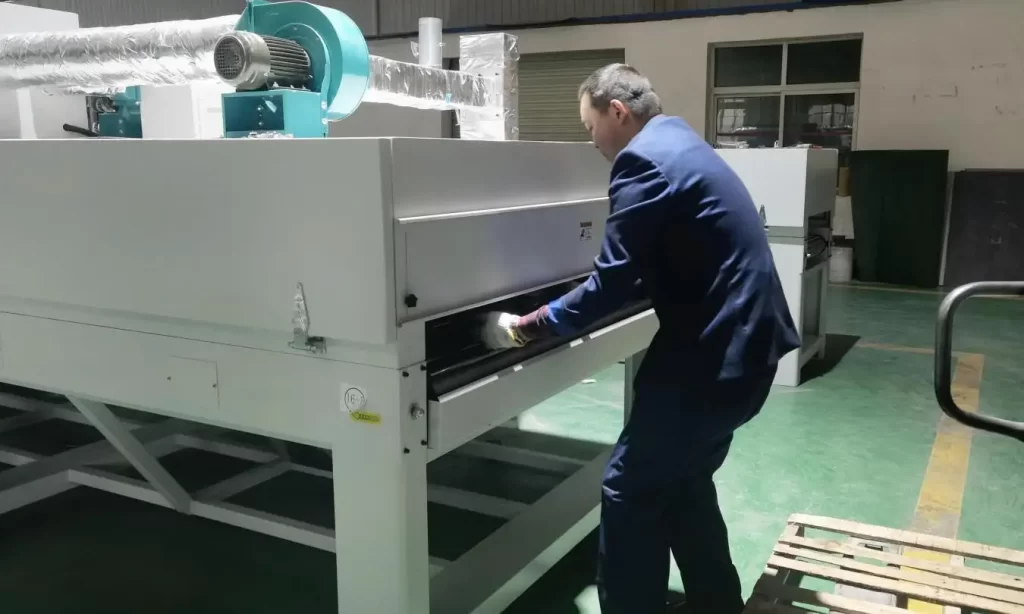
In one Senlian hotel-furniture project, the company reports a 56 m automated UV roller coating line running at 8–12 m/min, with an eight-hour output of 3,500–5,200 m² and 2–3 operators. These figures describe that specific project, not every Wood Coating Line.
The more useful lesson is the system design: surface preparation, water-based coloring, UV putty, primer, sanding, topcoat, curing and automated handling were configured around one production process.
Select the Process Before Selecting the Machines
A reliable Wood Coating Line should be designed backward from the finished panel:
Product → Surface Requirement → Coating Chemistry → Film Build → Line Speed → Curing → Verification → Equipment
For manufacturers evaluating automated UV finishing for MDF, veneer, solid wood or other flat furniture components, Senlian's UV Roller Coating Line provides a practical reference for integrating roller coating, surface preparation, UV curing, sanding and automated handling. The next step should be to test the actual workpiece and coating system, then configure the line around verified production parameters rather than nominal machine capacity alone.
FAQs
Q1. What products can a Senlian Wood Coating Line process?
Senlian Wood Coating Line systems are mainly designed for flat or relatively regular wood products such as MDF, veneer panels, furniture boards and solid wood panels.
Q2. What processes can be integrated into a Senlian Wood Coating Line?
A line can combine sanding, dust removal, roller coating, leveling, UV curing, primer sanding, topcoat application and automated material handling.
Q3. Does Senlian use UV roller coating in its Wood Coating Line?
Yes. Senlian offers UV roller coating systems that use metering and application rollers to control coating transfer on flat wood surfaces.
Q4. How fast does UV curing work in Senlian equipment?
Senlian states that compatible UV coatings can be cured in approximately 3–5 seconds on its standard UV curing equipment, depending on process conditions.
Q5. Can a Senlian Wood Coating Line handle water-based coatings?
Yes. Senlian can configure hybrid processes combining water-based coloring or coating stages with UV primer and UV topcoat processes.