



Hot Tags
How to Choose a Suitable Automatic Five-Axis Spray Painting Machine
August 17, 2026


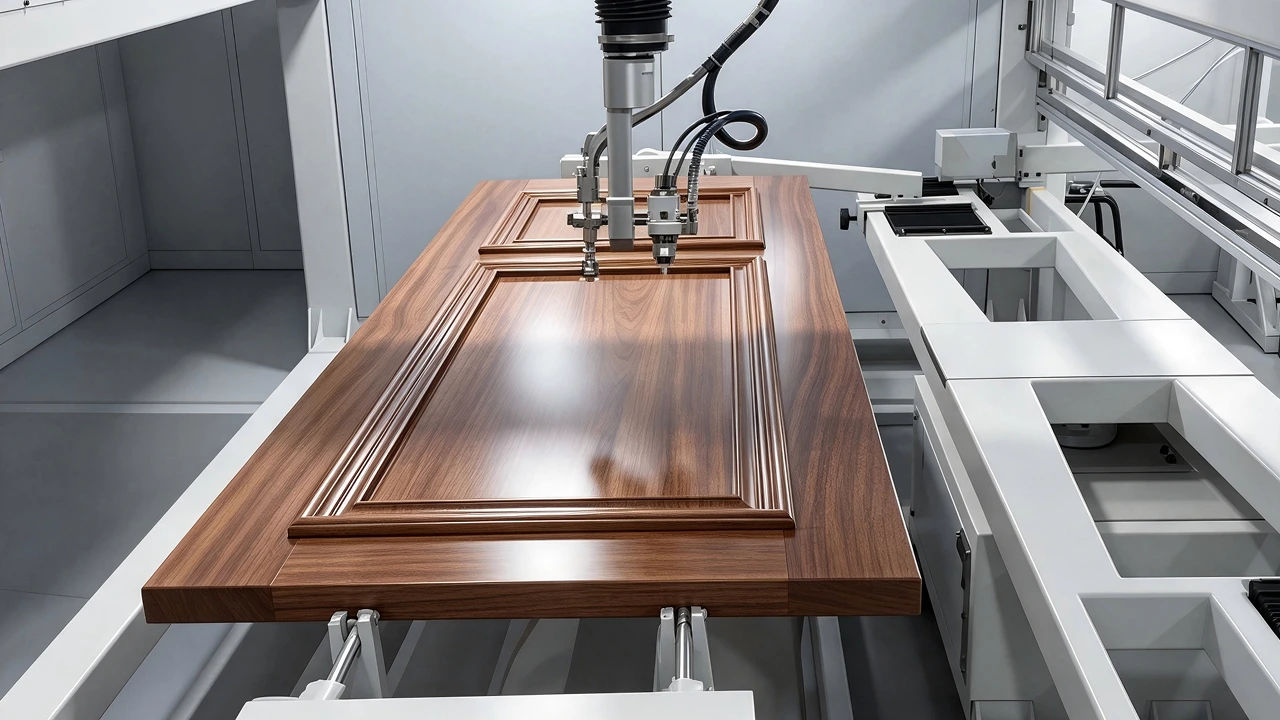
Senlian's automatic five-axis spray painting machine is widely used in industries such as wooden doors, furniture, display cases, sanitary ware, glass, automobiles, and semiconductors. It is mainly suitable for automatically spraying primer and topcoat on products such as doors and windows, frames, moldings, wall panels, cabinet doors, coffee tables, TV cabinet countertops, automotive parts, semiconductor components, and more. It has a particularly significant advantage when coating products with thicker edges or requiring double-sided coating.
However, Senlian offers many models and configurations of automatic five-axis spray painting machines. How should one choose a suitable automatic five-axis spray painting machine?
Choose based on your functional requirements:
Standard Five-Axis Spray Painting Machine: The standard automatic five-axis spray painting machine is the most widely used basic model, consisting of a complete motion system with three linear axes (X, Y, Z) and two rotational axes (A, B). This axis configuration enables it to move freely and rotate at multiple angles in three-dimensional space, allowing flexible adjustment of the spray gun's spatial position and operating angle to meet the spraying requirements of most workpieces with complex shapes. In terms of the control system, this model uses a PLC as its core, combined with a high-precision servo controller and a user-friendly touchscreen operation interface. It not only allows simple and intuitive parameter setting but also supports storing and memorizing spraying parameters for multiple product types. No repeated debugging is required when switching between products, which improves work efficiency. The feeding structure adopts a 180-degree indexing rotary table design, featuring low pollution and easy cleaning and maintenance. Meanwhile, key parameters of the spray gun, such as atomization effect, spray width, and paint flow rate, can all be accurately controlled remotely through a programmable computer to ensure stable spraying quality.
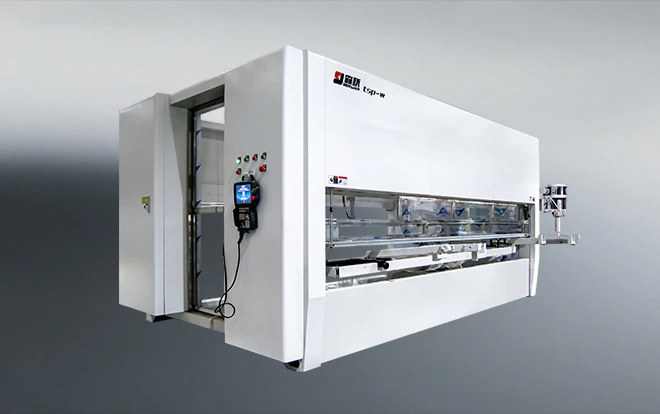
3D Scanning Five-Axis Spraying Machine: The core advantage of the 3D scanning five-axis spray painting machine lies in its integration of 3D scanning and intelligent path planning functions, providing an efficient solution to the spraying challenges of irregular workpieces with complex curved surfaces. Its workflow is as follows: first, it accurately acquires the three-dimensional shape data of the workpiece through 3D scanning equipment and automatically generates a 3D model, eliminating the need for complex manual trajectory programming. Then, based on the generated model, the system automatically plans the spray gun's movement trajectory, controlling the gun to move up and down quickly and switch angles, ensuring uniform coating on all edges, surfaces, and corners of the workpiece. This model is particularly suitable for spraying complex workpieces with multiple specifications and small batches. It can significantly shorten programming preparation time, reduce reliance on operator technical level, and avoid trajectory deviation that may occur in manual programming, thereby improving spraying accuracy and operational flexibility.
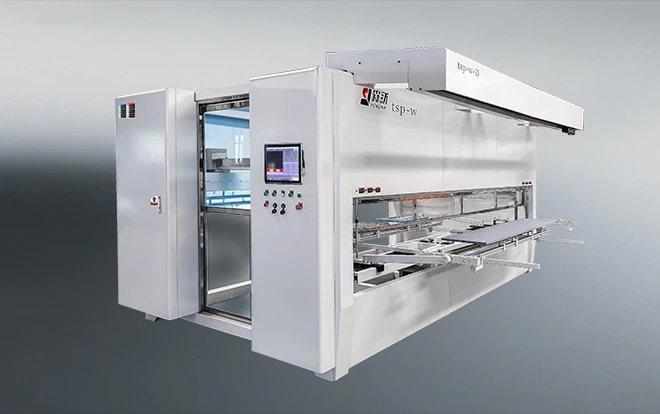
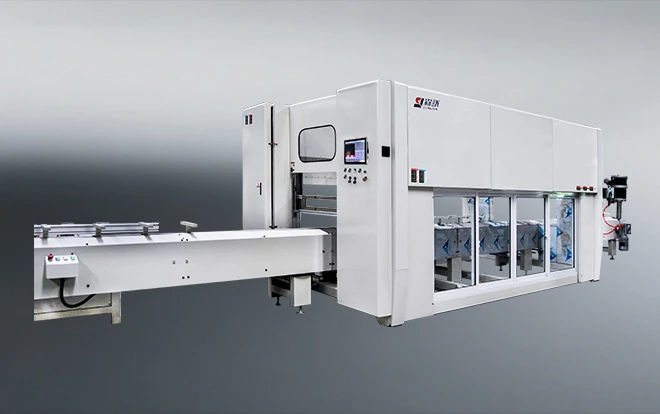
Forward-In and Backward-Out Five-Axis Spray Painting Line: The core improvement of the forward-in and backward-out five-axis spray painting line focuses on optimizing the conveying structure by upgrading the rotary conveying table in traditional models to a stepping conveying table. This conveying method completely breaks the limitation of single-machine independent operation and can seamlessly connect with equipment in the preceding and subsequent processes (such as loading and unloading machines, surface treatment equipment, and drying equipment). It can be easily integrated into automated production lines to realize continuous and assembly-line spraying operations. This design is especially suitable for the large-scale production needs of batch and standardized workpieces. On the one hand, it can significantly improve the operation efficiency of the entire production line and reduce the transfer and waiting time of workpieces between processes. On the other hand, the stability of stepping conveying can ensure that the spraying position and process parameters of each batch of workpieces are highly consistent, effectively controlling fluctuations in product quality. It is an ideal choice in industrial mass production scenarios.
Choose based on your investment budget:
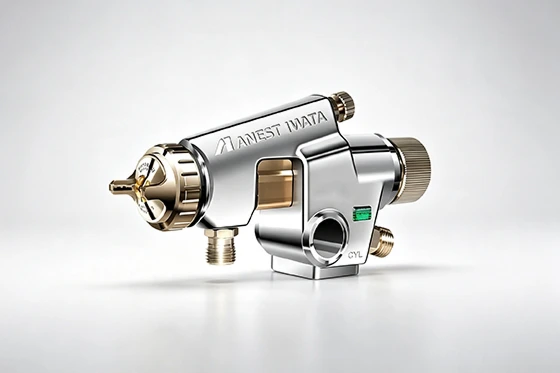
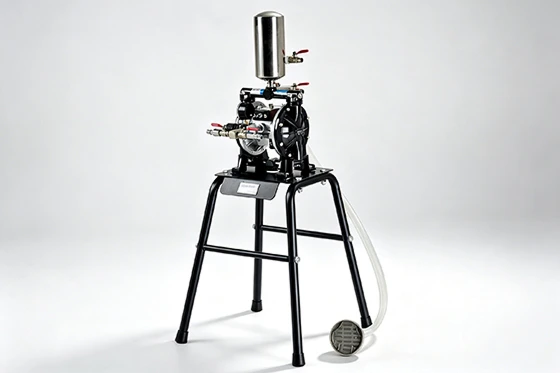
Japanese IWATA High-Pressure Air Spray Painting System (TSP): Senlian's SL-TSP automatic five-axis spray painting machine is equipped with two Japanese Iwata high-pressure air spray guns and one Chinese high-flow vacuum diaphragm pump. This combination meets the basic requirements of automated spraying and is the configuration chosen by most of our peers. It is mainly suitable for production enterprises with limited investment budgets.
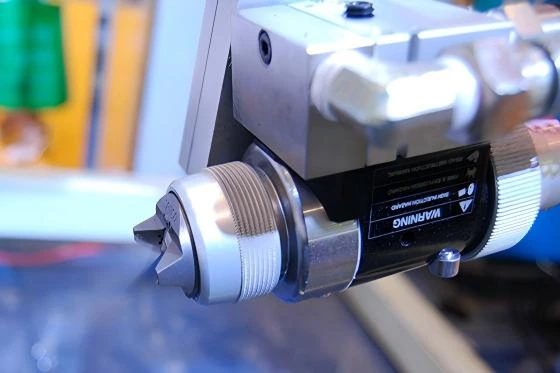
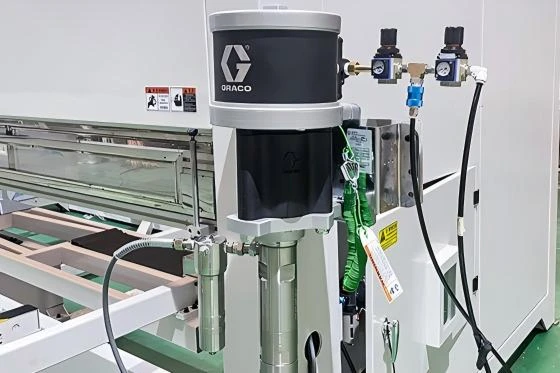
American GRACO Medium Pressure Mixed Air Spraying System (TSP-W/TSP-W-3D/TSP-WL-3D): The Senlian SL-TSP-W, SL-TSP-W-3D, or SL-TSP-WL-3D automatic five-axis spray painting machines are equipped with one Graco medium-pressure air-mixing spray gun and one Graco high-ratio plunger pump. Unlike traditional air pressurization methods, this system uses plunger-type physical pressurization to achieve better paint atomization. While traditional high-pressure air spray guns require 6kg of pressure to atomize, the medium-pressure air-mixing spray gun only needs 2kg. Lower pressure results in less rebound and higher coating quality. Most importantly, it saves at least 30% more paint than traditional high-pressure spray guns. Furthermore, our Graco 30:1 plunger pump has a higher ratio, resulting in lower plunger frequency, less wear, less noise, greater durability, and reduced maintenance costs.
Overall, while the Graco spraying system from the USA increases the initial investment cost, it offers lower operating costs, greater convenience, and superior coating quality. Furthermore, the price difference between the two configurations is not particularly significant, and the savings in paint and cleaning agent costs during operation will quickly offset the price difference. Therefore, we highly recommend choosing the TSP-W, TSP-W-3D, or TSP-WL-3D automatic five-axis spray painting machine for manufacturers with sufficient budget or high coating quality requirements.
In summary, the automatic five-axis spray painting machine is a high-performance piece of equipment for achieving automated industrial painting. Different models provide specific solutions for manufacturers with different needs. The table below provides a summary reference for your selection of an automatic five-axis spray painting machine:
| Model | Advantages |
| TSP | It meets the basic requirements of automated spray coating and is inexpensive, making it suitable for manufacturers with limited investment budgets. |
| TSP-W | It meets the high-quality requirements of automated spray coating, saves more than 30% of paint compared to TSP during operation, requires manual input of product dimensions, is suitable for manufacturers with relatively uniform product specifications, and has a moderate price. |
| TSP-W-3D | Based on the TSP-W, it adds a 3D vision scanning function. During operation, there is no need for manual programming or input of product dimensions. The machine will automatically generate the processing path, bringing greater convenience and efficiency to the operator. It is especially suitable for manufacturers with many product specifications, small batches, or irregular product shapes. |
| TSP-WL-3D | Based on the TSP-W-3D, it optimizes the 180-degree rotating worktable into a stepping conveyor line, enabling seamless connection with surface treatment, paint drying, and other equipment. This further improves production efficiency, reduces manual labor, and realizes a fully automated industrial coating production line. It is ideal for manufacturers with comprehensive high requirements for coating quality, efficiency, convenience, and automation. |